
Inspiration
Deliverance: Juan Downey, Peter Hujar, and me.

The film Peter Hujar’s Day is out, but it won’t be screened in Nashville, at least not for its debut. I assume it’s because it’s too gay for Tennessee. It opens in Louisville, Kentucky, on December 5th. I am considering a road trip.
The book upon which the film is based was conceived of and then recorded by Linda Rosenkrantz on December 18th, 1974. It is 36 pages long. There are four photographs in the book: one of Peter and Linda, an author headshot of Linda, and two quite ordinary frames that are details from a contact sheet—a wide shot of Hujar’s loft in New York.
In talking with a friend about Hujar (okay, I was texting), I was catapulted back to the 80s and the AIDS crisis and started thinking about the brilliant artists we lost far too soon and the lasting impact their work had on me. To be fair, this notion of brilliance was also prompted by thinking about what makes art great—or even good—in part because, as an educator, I had to cross a line in the sand and accept that all work is “A” work nowadays.12 But that’s another post. Or not. It might be this post- we’ll have to wait until I finish writing.
This led me to reflect on Peter Hujar’s Day. I miss this era. Is it nostalgia? Maybe, although I was too young to have experienced this period in art firsthand, as Hujar was just 12 years younger than my father—a fact that suddenly seems so incongruous to me. Hujar would have been 41 years old on the day the conversation took place. I was 13 years old on that day. At 40 and 41 years of age, respectively, my parents and I were living in a suburb of Atlanta, Georgia. In 1974— the day the conversation took place—our nuclear family was living in what was then a rural suburb of Nashville. Even with my early affinity for art, the cultural gap could not be wider. It should also be noted that two years prior, the film Deliverance was released in Nashville, playing at our local suburban theater in Green Hills. I remember this because my father was going to take me to see the film, having heard it was filmed in rural Georgia, where his ancestors hailed from. He thought it would be an opportunity for me to see the Georgia wilderness on screen. As the opening neared, I was excited. Before anyone thinks this scene played out in full, my dad discovered that the Georgia wilderness, and thus the film, contained a subplot, something he didn’t care to explain to an 11-year-old. It wasn’t until I was an adult that I figured that one out. But I digress. I don’t know why I’m making these connections. It’s just something I do.
Non sequitur:
“I do not recall whether I read or dreamt that Marcel Duchamp had said that some artists continue painting because they are addicted to the smell of turpentine. Their activity is therefore not aesthetic, but is instead a biological dependency of the chemistry of that medium.”—Juan Downey, from “The Smell of Turpentine,” one of my favorite essays.3
I woke up too early this morning at 4:45 a.m., but that’s okay because I went to bed at 8:45 p.m.
I’ve been up and working for four hours already.
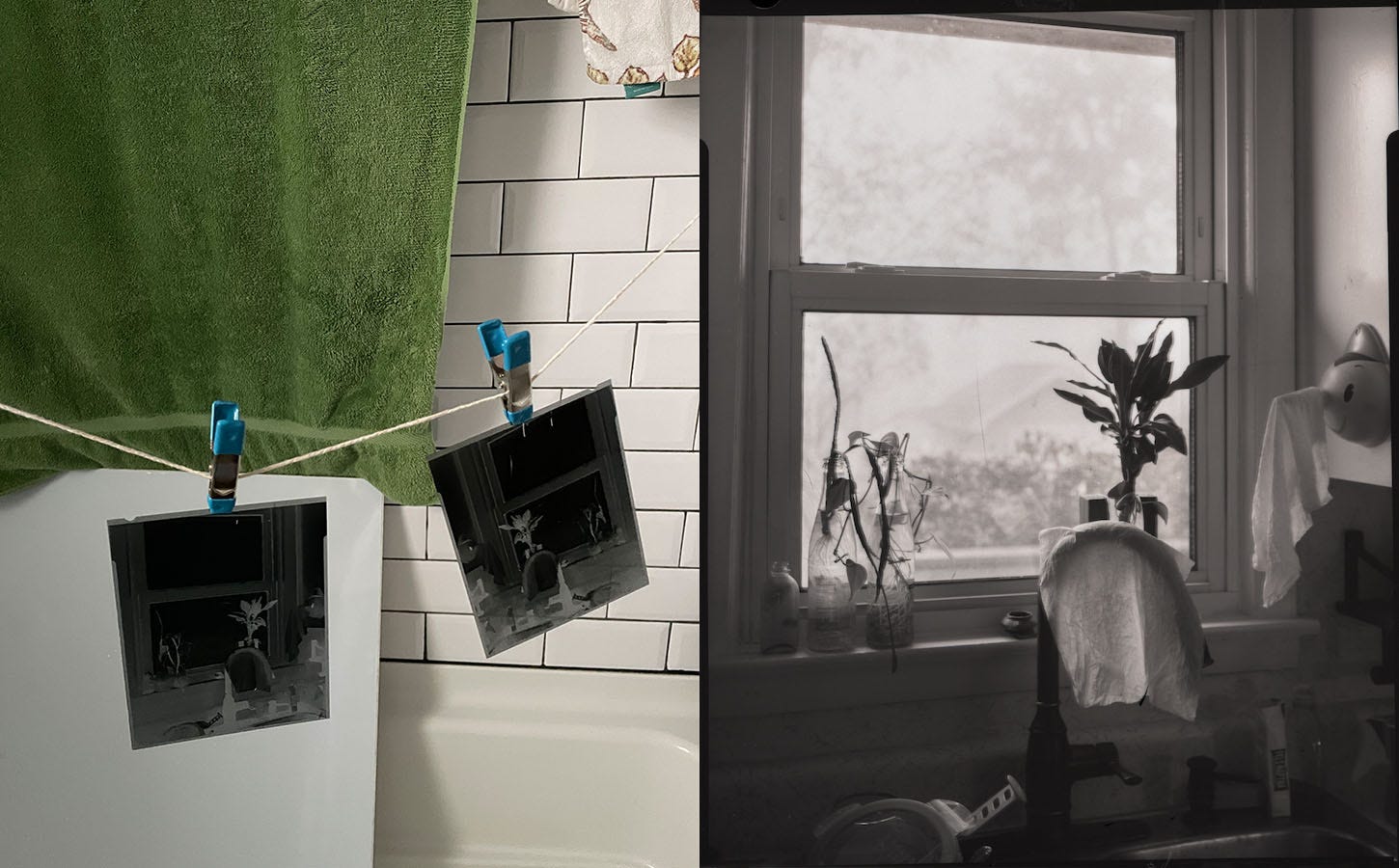
The fog. It was the fog. At that hour (5 a.m. by the time I made the bed and entered the kitchen), the kitchen window was softly backlit by fog. Not a big deal, really, but the paper towel I had hand-washed instead of tossing was drying, and the light hit it just so. The cuttings are still in bottles filled with murky water, and I’m sure everyone is bored to death with seeing another black-and-white image of my windowsill, but here we are. Again.
Minutiae: I’ve been working with in-camera exposures on fiber-based paper. While my exposure times are no longer double digits, “B” is still the default shutter speed mode, though it now stands for “Behold,” as in, “Behold, I’m experimenting with fast film.” I guesstimated the developing times and repeated a 1-minute song from Green Day as my official timer, counting off the seconds roughly while often getting lost during the pause in agitation. I’m still perfecting this system, but I’m also embracing it for now. Which is all to say that my home/studio/darkroom is jury-rigged to the hilt.
If you’re new to Nothing is Too Banal, thank you—and of course to the rest of you diehards as well. I do hope the publication title has clicked.
I’d like to quote Mark Fisher here. Instead, I will simply direct you to “Capitalist Realism.” Chapter 4, to be specific. You’re welcome.
I’m not going to be bullied into using commas just because AI has been training on the likes of me and my fellow em dash aficionados. Em Dashers, Unite!
I first read this essay in grad school when I was working with video. Downey, also a video artist, uses this quote to playfully evoke the physical qualities of the editing room—his own “smell of turpentine.” I’d argue that nearly everything I do as an artist is habit-forming to a degree, but, O Darkroom! My Darkroom!